
Introduction and Background
Formative Stage (1940- 1980)
There were children and youth development ministries as well as education, training, water, sanitation, health and nutrition activities that were implanted into the EKHC undertakings that were co-implemented with its founding mission organization, SIM
Established 500 schools , 4 health clinics and 6 hospitals, development water points and many other sanitation and hygiene and nutrition activities in the communities wherever the EKHC local churches were planted
Decline and Revitalization Stage (1980-1994)
Confiscation and nationalization of EKHC properties and shutting down all of the community development services’ initiatives by the communist regime
Revitalization in a new way with relief and rehabilitation work (North Wello) at the beginning of 1984
Growing Stage (Since 1994)
Registered by the Federal Democratic Republic of Ethiopia, Agency for Civil Society Organizations (CSO) under registration number 1218
Impacted most parts of Ethiopia with multifaceted projects: Health Projects (Clinics, public health, Sanitation, HIV Aids (Won Toronto Award, many other awards), Integrated Water, Sanitation and Hygiene Projects (Bore hole and Spring tapping, water points development, sanitation and hygiene trainings), Integrated Education, Training, Church and Community Capacity Building projects (Basic literacy and numeracy, Empowering and equipping church and government schools and communities, and education in remotest places and emergency situations), Integrated Child and youth development (OVCs, child and youth sponsorship program, and others)
Currently there are 118 projects under SSCB Programs Directorate all over Ethiopia except Afar Regional State. In the past six months, the direct beneficiaries85,253 (36,387 male and 48866 female) . The total bi annual expenditure was 366, 390,910.69 Eth. Birr, and out of this the program cost was 319,027,879.57 Eth. Birr (87%) and Admin Cost was 47,363,031.12 Eth. Birr (13%).
Purpose
The purpose of SSCBP is to equip and enable the program beneficiaries to bring about sustainable development by taping their available resources to fulfill their holistic life needs.
Goal
The Goal of SSCBP is to see holistically transformed communities living in a healthy environment provided and capacitated with sustainable social services.
Objectives
- Provide clean and potable water, and promote hygiene services to the most dispriveleged people in disadvantaged areas of Ethiopia
- Ensuring nutrition and health security by achieving a sustainable reduction of diseases and improve the availability, accessibility and utilization of adequate, diversified, safe and nutritious foods in target areas of Ethiopia
- Meet the holistic (physical, psycho-social, mental, educational, economic and moral) needs of children and youth from poorest of poor families who live in the current target and potential EKHCDC expansion program target areas in Ethiopia
- Strengthen and empower the target beneficiaries and EKHCDCs capacity through undertaking a multifaceted education and training projects for the welfare of target communities’ and EKHCDC’s development undertakings and sustainability in Ethiopia.
Core Activities
- Integrated Water and Sanitation Program Activities
- WASH, WETC, Water Quality Test (CAWST and GAC)
- Water Points Maintenance and Rehabilitation (TFAU and DFAT (Department of Foreign Affairs and Trade/Australian Aid)
- Access to quality potable water (Cost recovery surface water development & drilling Bore hole wells)
- Health and Nutrition Program Activities
- Prevention and care for HIV-AIDS patients
- Gender-based Violence (GBV) Prevention & Comprehensive OVC interventions
- Provision of clinical health services (Homosha Clinic)
- Quality and improved nutrition services
- Integrated Child and Youths Development Program Activities
- Child Sponsorship (CIE & One Child Ethiopia)
- Holistic Care for orphans and vulnerable Children (Sebeta Chidren Center by ICA & Aid Development
- Education and Training Program Activities
- Child Literacy and Numeracy (TFAU projects)
- Enhance Quality and Inclusive Education (EQIE Adaa Project /RTP)
- Equip and Empower EKHC KiSchools (EKHC Schools, DaVXchange/
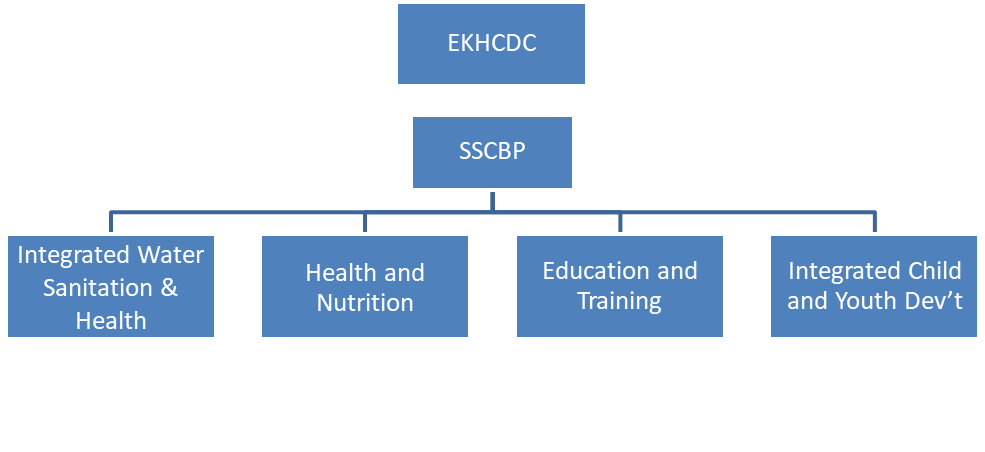
SSCBP Program Organogram
Individual Program Presentation
- Integrated Water, Sanitation and Hygiene Program
- A. Introduction
The EKHCDC’s Integrated Water, Sanitation and Hygiene program is working on the revised five-year strategic plan of the commission that targeting to achieve the SDG (Sustainable Development Goal) of the country. The program supports in supplying potable and adequate water to people living in different rural communities of the country and it had brought a significant value added change and improved the well-being of women, children and youth as a whole targeted community by reducing walking distance and incidence of water and sanitation related diseases through provision of safe water supply and awareness creation on personal and environmental hygiene and good sanitation practice.
B. Objectives
The EKHCDC’s Integrated Water and Sanitation program activities are the well-known and have been operational since 1984, targeting different communities in urban and rural areas of Ethiopia. The program provides safe drinking water with aiming to improve the health and food security conditions of beneficiary households. Also, it trains the beneficiaries on how to manage and maintain their WASH facilities and services for effective and sustainable use of the water infrastructures. Besides this the program ultimately aims to enhance women’s ability to improve their health and well-being, and thereby increasing their value and status within the community, and contributing to broader societal improvements.
C. Core Activities
water well drilling in Bale Zone Ginir and Gololacha districts
390 M large plastic ሰ products for artisans handed over to 13 kebeles across 3 districts
WaSH awareness training was conducted for 16 school WASH club members in Abeshge
DEWT training was delivered to Community WASH promoters (CWPs) in Abeshge District.
GAC Project mid-term evaluation was conducted in 3 districts with government signatory bodies. (Regional, Zonal, District and local church
Capacity building training by MAJI Safi group from Tanzania on implementation of Menstrual Hygiene Management (MHM) for women CWPs and head office staff
MHM training sessions for MHM school club members were held in Misha (84 participants) and Kachabira (88 participants).
D. Major Achievements
Two spring developed at the Misha and Dilla districts;
Seven water well maintained at the Misha, Dilla and Lok Abaya districts;
One Spring maintained at Dilla Ditricts;
Rehabilitation of Sebeta Water well
Rehabilitation of Presbyterian church water scheme rehabilitation
Conducting a water quality test
Conducting a geophysical survey for a water well drilling
- Health and Nutrition Program
- Introduction and Background
EKHCDC the health/medical department established 30 years ago
Historical the successful period of the department goes back the 9 health and HIV/AIDS prevention, care and support programs units formation in 9 major towns across the country.
It was known with its popular name of the projects called “Medan ACTS (AIDS control and treatment services)” which sited in Addis Ababa, Shashemene, Hawassa, Dilla, Wolayita Sodo, Arbaminch, Jimma and Dessie.
Under the department health and health related project have been implemented and benefited ten thousands of people in each years
Major focus area of the department includes HIV/AIDS prevention, testing, treatment, care and support; maternal and child health care, family planning, TB case detection and treatment, community Nutrition, malaria prevention, Hygiene and Sanitation, and clinic based health services
- Objectives
General objective:
To improve the health and well-being mother, children and other adults
Specific objectives:
Improve Maternal, Neonatal and child Health (MNCH) and Adolescent health
Prevention, control, care and treatment of HIV/AIDS, TB, Malaria and other communicable and non-communicable diseases
Prevention of malnutrition and improve nutrition status of mother and children
- Core Activities
Knowledge and skills on nutrition improved, Strengthen the Pregnant Women Conference (PWC) experience to promote and reinforce improved nutrition behaviours, conduct Enhanced Community Conversation, Conduct community nutrition day (CNDs) /events, Conduct Family dialogue conference with family members of PLW , Conduct husband Nutrition Forum (husband of pregnant women participate), Conduct cooking demonstration,
Access to Quality Nutrition services improved at community level, Conduct Nutrition Services Mentoring to targated Health Post, Support the health facilities to provide quality nutrition services, facility-based quality improvement coaching visits at all project facilities, strengthen supply chain management at health facilities to ensure timely availability of necessary supplies and commodities for nutrition activities
Capacity and coordination improved among nutrition stakeholders across sectors, Conduct Biannual multi sectoral (MS) JSS at Woreda and Kebele Level, establishment and strgthen of woreda and kebele-level Food System and Nutrition Councils (FSNCs) in target woredas, Provision of fruit and vegetable seed and technical and financial support to households for backyard gardening, Vegetable or Fruit Gardening establishment in school, Health center or Health post,
Gender, Youth and Social inclusion (GYSI Activities:), Support the establishment of two nutrition clubs per Woreda and support nutritional screening for in and out of school adolescent girls, Conduct one time meeting with Husbands of lactating and pregnant women, Strengthening Youth Friendly Services(YFS) in selected PHUs, BMI assessment and Iron Folic Acid support
Community HIV testing Services (index case testing), increased new case identification to achieve the 1st 95% (95% of individuals living with HIV know their status) and also ensure accompanied linkage to heath facilities for treatment.
Treatment Growth and Continuity of Treatment Standards of Care
Decentralized drug distribution (DDD)
Gender-based Violence (GBV) Prevention
Implement Comprehensive OVC interventions
Improve primary prevention of sexual violence and HIV infection for 10-14 years old girls and boys.
Diagnostic Health Services
Maternal Health Services
Child Health Services (including EXPANDED PROGRAMME OF IMMUNIZATIONS (EPI))
Improved farming CA (conservation agriculture promotion)
Small irrigation and multi seasonal farming
Bee keeping, poultry promotion and other economic empowerment activity
- Major Achievements ( see the annual report of 2023 and Bi annual report of 2024)
- In three towns client centered and voluntary based HIV testing provided through ICT model introduced and a total 935(78%) ICT testing conducted for client’s sexual partners, spouses and non-spouses, biological children and others and identified
- A total of 84 (75%) new HIV positive identified and linked to tx
- In IIT return 81(80%) of lost reengaged
- In CHCT comprehensive case management services provided for 501 (99%) clients and achieved from the annual target and expressed by sex as male 139(28%) and female 362 (72%).
- a total 759 clients have got cervical cancer demand creation and 79 clients referred to health facilities after community based screening by project community engagement facilitators and 4 (10.4%) clients identified as positive for CXCA and linked for treatment and under follow up.
- Through case management comprehensive services provided for 7458 OVCs and 1520 care givers.
- In economic intervention 12 VSLA groups with 182 members, and 181 CGs (299 OVCs) with asset transfer (AT)
- a total of 470 CALHIV (Arba Minch= 180, Jinka =19 and Soddo= 251) in the FFHPCT OVC program offered and 450 OVCs 96% of the total OVCs in TX_CURR (Arba Minch = 170, Jinka= 57 and Soddo= 223) enrolled and served in compressive services and 16 HVL children identified, barrier analysis conducted and served.
- In OVC prevention, 982 (59%) adolescent girls with IMPOWER & 520 (86,6%) adolescents in CBIM modular trainings provided. Which attempt to change the deep-rooted attitudes and behaviors that foster GBV, as the outcome of the primary prevention 8 adolescent girls disclosed their GBV case and post GBV screening conducted and to link the OVC comprehensive service.
- A total of 313 (60%) targets reached with SINOVUYO prevention activities that designed for adolescent children aged 10 – 14 & their caregivers to train them with the basics of good parenting skills.
- a total of 119 (79%) small farmers trained on conservation agriculture (CA).
- About 15(60%) needy small farmers identified and supported with improved seeds of field crops (maize) and fertilizers, and they planted their crops by using the principles of CA.
- 78 (75%) individuals/household in 6 groups
- self-help group (SHGs) established and trained on small business basic principle, and supported with poultry farming, 23 chickens and 2 cock per groups and total of 150 poultry distributed after the community construct houses for poultry.
- In irrigation farming around 20 (133%) small farmers form two self help group (SHG) from two kebeles and trained on small-scale irrigation and multiple seasons farming
- In bee keeping 5 (100%) HHs selected and trained on honey production, and management and distributed five modern hives in collaboration with woreda livestock experts.
- Maternal health (all types of family planning) 863 (50% of annual target)
- Free MCH services 357 (97%)
- Maternal health (ANC services) 283 (77%)
- Iron/Folic Acid Supplementary for pregnant woman 294 (80%)
- Institutional safe delivery service (in project Clinic) 199 (54%)
- 45 Pregnant Women Conference (PWC) conducted
- OPD adult 3457
- Under five OPD 712
- Community volunteers identified and trained
- Woreda based food and nutrition council established
- Integrated Child and Youth Development Program
- Introduction and Background
Integrated Child & Youth Development Program is newly formed program under the EKHCDC/SSCB directorate with assisting and managing child and youth development projects under the Institutional Child Care Center ( Sebeta) and Home based and Family Based approach ( Child and Youth Sponsorship program)
The Child and Youth Sponsorship program are supported by two existing donors. One Child International Eth. And Compassion International Eth. Whereas the Sebeta Orphan Center is donated by the two individual donors to support 26 children and youths at the center.
Integrated Child & Youth Development Prjects donated by CIE started its operation in November 23, 1993 G.C as a pilot Child Development program under the EKHCDC, Fellowship and Akaki Local KHC.
Currently the ICYD program operates its holistic program and services to the children and youths through 106 projects at the EKHC local churches.
The Program currently intervenes its holistic supports to the children & youths in 13 regional states throughout the country. ( Tigray, Amhara, Oromiya, Gambella,BSG,Somali,Diredawa Adm.,Harari,Sidama,South West Eth.,Central Eth, Southern Ethiopia and Addis Ababa Adm. City) with 613,098,230.20 ETB donation from three donors.
Currently the program is running its services and operations by two HQ staffs and 468 project sites staffs/officers and other hundreds of volunteers at the local churches.
The program leads and manages 468 project staffs 265 Females and 202 male staffs under 106 site projects.
Currently the Program is initiating to launch additional 4 New projects in Jimma Zone Sokoru, Asendabo towns and in Central region, Yem Saja Towns.
- Objectives
General Objective
To improve the wellbeing of 25,416 children and youths with assisting physical, educational, economical, social and psycho-emotional components to vulnerable children, youths and their families those are selected from the poorest affinity groups in target area in all over the country.
Specific Objectives
- Support and benefit 25,000 children through the sponsorship program, 25,000 Children, Youths and their families/guardians through foster care and youth empowerment and family empowerment programs by releasing their hidden potentials under the community.
- Improve child and youth provisions to the holistic transformation; Economic, Social, Physical, Cognitive and Psycho-emotional transformation that focus on gender balance.
- Equip and empower children and youth in the communities with providing various skills and vocational software trainings to create job and employability access under the community so that they would be self-supporting and productive citizens.
- Equip and empower their guardians and families under the program in various skills so that they would be self-supporting and productive citizens with generating Incomes in small business through the SHG approach.
- Equip and empower the leaders and project staffs to ensure an effective leadership and project management quality
- To improve the wellbeing of 25,000 children and youths in physically health and influencing positive on their friends and neighbors who are not benefited from the program directly within the community.
- Minimize Conflicts and Youth migrations by providing intensive trainings and awareness creation to solve their problems by the internal resources. Like creating jobs to the youth with creating alliance to the other donors and supporters of the program.
- Core Activities
- Provide institutional and home care for 25,000 children and youths under the program.
- Supports through sponsorship and foster care for the children under Sebeta Orphan center.
- Life and vocational skills for grown up children and youths through home based and institutional care.
- Trainings for 25,000 children and their guardians/caregivers, families and other beneficiary communities on the topics such as child raising, children rights, SHG, IGA, entrepreneurship, avoiding harmful traditional practice (against FGM and child abuse)
- Empower families with establishing SHG under the community level and inject money to the group to improve their loan amount of the individuals in the group.
- Provide Job creation and Employability trainings for youths and their families in IGA and Other sustainability programs.
- Develop proposals and search additional funds from the external donors and mobilize internal resources to manage the child center program by the resources local resources.
- Six Months Achievements
- 2,447,008.00 ETB internally mobilized by the 27 projects under the EKHCDC/SSCBP-ICYDP for the last six months only.
- 116,200 ETB has been mobilized by the local church and support the children who did not get the chance to register and attain at the project.
- 75 houses were renovated by the project staffs, church communities as well as the community.
- One local church was mobilized its congregation and purchased 150 chairs by providing 45,000.00 ETB .
- 50 professionals and Health doctors were mobilized by the local churches and they gave free physical diagnosis service to the project children and youths in the project sites.
- Some projects got additional office renovation supports from the CIE.
- 3 project offices and local churches got Water and Electric supply by the CIE support.
- 1,150,000.00 additional Disaster and Flood protection supports received from the CIE for Wolenchiti ET-163 project.
- 16,890,000.00 ETB DRF support from the CIE out of the program fund for the last six months. Our project staffs, volunteers and other church stackholders were benefited by the DRF support in Debre Biran ET-131, Mehal Meda ET-165, Kombolcha and Desse Projects.
- 361,586.87 ETB Supports to the EMdibir Et-171 projects in the last sic months for the church compound innovation and WASH program.
- 25 projects have been conducted extensive monitoring and Audit.
- 106 Projects have been audited by the external auditor and they received their audit reports.
- The Sebeta project meet the basic needs of 26 orphan children and to build them educationally, socially, ethically, and physically in order to make them productive & responsible citizens at the end of leaving from the center.Ensure the girls engagement to attend in schools provide food and shelter for the girls under the center of orphan.
- (4) students join university these are Nhomine joined A.A university Minilik Hospital in medicine third year, Hana who joined Aris university second year nursing field of study, Gifte also joined Arsi university, Berhian Mhariy she joined Wolekete university with attending remedial class.
- Counseling service has been given to the girls under the institution by a professional counceler in Addis Ababa City.
- Education and Training Program
- Introduction and Background
Education and training are most important aspects of human development and they can play great role in socio-economic transformation of a society. The history of the Ethiopian Kale Heywet Church’s intervention in education and training activities dates back to its establishment in 1928. From 1927-1940, the focus was on functional literacy and numeracy and health and sanitation activities wherever the EKHC local church was planted. Though this movement was encountered by challenges posed by Italians and infrastructural problems of the day, it exerted great positive impact on the communities were church literacy and numeracy and health centers were established.
In the years 1941-1974, fascinating development happened in the church and its founding mission/SIM joint projects and schools in the country. The pre-primary Literacy and numeracy centers were grown and there were about 500 elementary and secondary schools. . Also there were several formal and non-formal trainings going on in many stations and churches in Ethiopia. Health clinics and hospitals were established in the strategic places of Ethiopia
From 1974-1991 the EKHC Schools were nationalized by the communist government and many development activities were closed because of the change of policies in the country. However, the church continued to carry out educational and training activities in some places and mostly in remote contexts in underground.
Since 1991, the federal democratic government of Ethiopia opened up doors for the church to carry out its educational and training activities in broad way. Beginning 2002, the EKHC revitalized its educational and training activities and initiated many multi-million projects. These projects were organized under the education and training program. Currently the program manages 360 Kindergarten to high school level schools, and it oversees literacy and numeracy, and enhance quality and inclusion education projects.
- Objectives
Major Objective
Equiped and empowered EKHC DC educational and training undertakings that ensure educational and training access equity, inclusiveness and quality in target areas of Ethiopia
Specific Objectives
Improved children literacy and numeracy in pre-primary schools in the target areas of Ethoipia
Provided teachers and leaders professional development trainings that bring improvement in EKHC Schools and in other public schools in the target areas.
Improved EKHC Schools that equiped with educational materials equipment and facilties meeting the national standards of Ethiopia.
Improved curriculum materials that foster children learning in EKHC pre-primary schools (Piloting at Bole and Asko)
Excelled EKHC schools that effectively implement and ensure sustainability in today’s competitive market
Core Activities
Work with special students and inclusion of girls and Children with disabilities(CWD)
Adapting and Integrated curriculum and curriculum materials to target areas
Collaboration Networking Nationally and Internationally in enhancing Quality and inclusive education
Provision of Life Changing Technologies (LCT) to effectively cascade educational and training activities
Capacity building, training to school teachers and principals/Directors
Promoting stakeholders engagement for education and training enhancement among target communities
Ensuring improved and quality Pre-primary and primary educational success of the 360 EKHC Schools and literacy and numeracy centers
6 Months major achievements
- The total of 3,935 children (male 1963 female 1972) registered and have been receiving literacy training in 72 program sites. Of which 50 children (29 male 21 female) are those with various disabilities.
- 72 facilitators trained on topics like teaching methodologies, lesson planning, continuous assessment, teaching aid preparation, beneficiary (child) protection, disability inclusion etc.
- Educational materials: – purchased and distributed to 72 program sites found in 5 districts.
- The total of 31 Child mothers SHGs with total number of 668 members established and have been followed up. Their total capital reached to about Birr 105,000.
- Conducted need based training for 23 CSOs representatives in how to identify out of school children and facilitate enrollment of Children in school.
- Conducting mentorship and technical back up support for 53 School inclusive committee on how to address barriers to education with the community.
- Joint learning through experience sharing among local Community based organizations and annual review meeting with community.
- Regular monitoring of 18 schools.
- Support back to school campaign with attention to girls and CWD by doing door to door visit in 18 public schools and 72 literacy and numeracy centers
- Conduct community conversation on child protection
- school principals and teachers Training
- school leadership Training